
What Makes Claude Exceptional
Let's be direct: Claude is one of the most impressive AI systems available today. Its reasoning quality is genuinely best-in-class. It handles nuance, ambiguity, and multi-step logic better than nearly any other model. Its context window is among the largest available, which means it can hold an entire codebase worth of content in a single session if you supply it. It produces structured output — specs, acceptance criteria, technical breakdowns — with a clarity and consistency that is hard to match.
This is not a dismissal of Claude. In fact, Feature1 uses Claude directly. Our Copilot mode runs Claude Code as the MCP driver, following the Driver-Navigator pattern where Claude Code drives implementation and Feature1 navigates it through your codebase. Claude is a genuine partner in the Feature1 workflow, not a competitor to it.
The question is not whether Claude is capable. The question is whether Claude alone — used as a standalone planning tool — is sufficient for feature planning on a production codebase with a real team. The answer is no, and the reasons are structural, not about model quality.
The Gap: Claude as a Standalone Planning Tool
Claude is a powerful reasoning engine. But feature planning for production software has specific infrastructure requirements that a conversational AI cannot satisfy on its own, regardless of how capable the model is.
- No persistent codebase context. Claude can read files you paste into a session. But it does not maintain a knowledge graph of your codebase between conversations. Each new chat starts fresh. Claude does not know your architecture, your naming conventions, your existing data models, or the decisions made three sprints ago. You re-explain the same context repeatedly, and it degrades over time.
- No team sharing. Claude conversations are single-user by design. There is no shared planning thread your PM, designer, or CTO can join with status tracking. Decisions made in a Claude chat stay in that chat. The rest of the team works from a screenshot or a copy-paste, not a living record.
- Plans stay in the conversation. Claude generates excellent specs. But those specs live in a chat window. There is no automatic conversion into user stories, acceptance criteria, or sprint items. Someone still has to manually translate the output into whatever project management system the team uses — and that translation is where detail is lost.
- No execution bridge. Claude can write code, and Claude Code can make changes. But without an orchestration layer, there is no automatic branch creation, no PR tied to specific acceptance criteria, and no tracking of which parts of the plan have been implemented versus which are still pending. The plan and the code live in separate systems with no verified connection.
None of these are failures of Claude's intelligence. They are the natural limits of a general-purpose conversational interface applied to a workflow that requires persistence, collaboration, and execution.
Claude + Feature1: Better Together
Feature1 does not replace Claude. It gives Claude the context and execution infrastructure it needs to be genuinely useful for production feature planning. The relationship is additive.
- Domain Spec feeds Claude codebase context via MCP. Feature1's Domain Spec is a living knowledge graph of your codebase — architecture, patterns, data models, conventions. It is supplied to Claude via the Model Context Protocol so every plan Claude generates is grounded in what actually exists in your codebase, not a generic approximation.
- Claude Code as the MCP driver in Copilot mode. Feature1's Copilot mode uses the Driver-Navigator pattern — Claude Code drives implementation while Feature1 navigates it through acceptance criteria, codebase context, and implementation state. Claude's full coding capability is applied with precision, not in a vacuum.
- Plans automatically become user stories and ACs. When you plan a feature in F1 Assistant (powered by Claude), the output is not a chat message. It is a structured feature with user stories and acceptance criteria that persist in the platform and are immediately available for implementation.
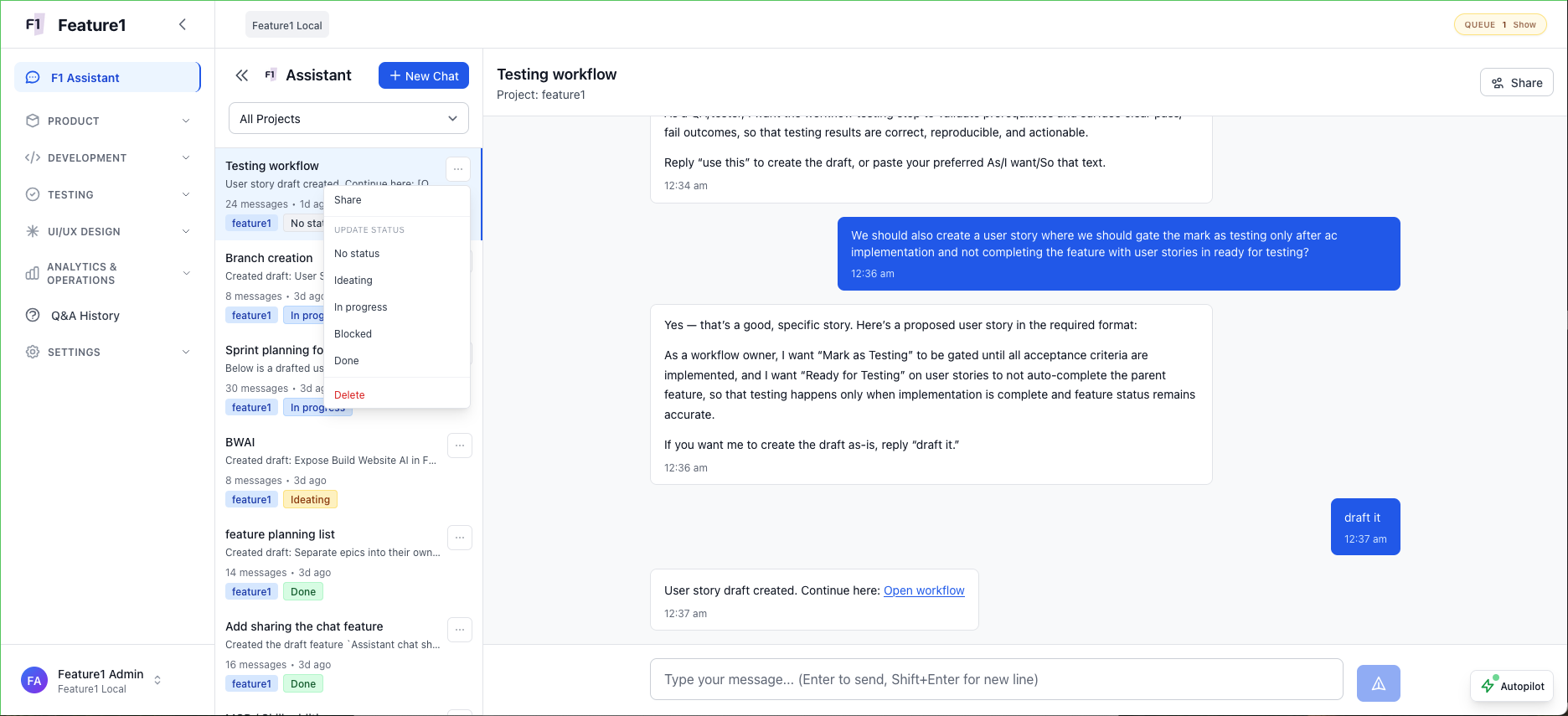
F1 Assistant (powered by Claude): shared threads with status tracking. Conversations become user story drafts instantly.
- Full visibility into code changes. Your repository is connected to Feature1. The AI agent runs directly in your codebase — every commit, every diff, every branch is visible. Feature1 doesn't just track which ACs are "done" — it knows the actual code changes, which files were modified, and how each change maps to the plan. Pull requests are created automatically with full context.
See the full plan-to-PR pipeline to understand how each step connects, from the first feature idea to a merged pull request.
Side by Side
Here is a direct comparison of what you get when using Claude alone versus Claude operating inside Feature1.
- Best-in-class reasoning
- Session-scoped context only
- Single-user conversations
- Plans stay as text in a chat
- Same reasoning + persistent codebase context
- Domain Spec knowledge graph across all sessions
- Shared team threads with status tracking
- Plans → Stories → ACs → Code → PRs (repo connected, every change visible)
You are not choosing between Claude and Feature1. You are choosing between Claude with context and execution infrastructure, or Claude without it. Explore the full platform feature set to see what the complete workflow looks like.
The Takeaway
Claude is the engine. Feature1 is the chassis. An engine without a chassis is impressive engineering on a test bench. A chassis without an engine does not move. Together, they ship features.
If you are using Claude directly for feature planning today — pasting in files, regenerating context every session, copy-pasting specs into Jira — you are getting a fraction of what Claude is capable of delivering. The bottleneck is not Claude. It is the absence of the infrastructure that lets Claude's output actually reach production.
Feature1 is that infrastructure. And because Feature1 runs Claude Code as its implementation driver, you are not trading off model quality for workflow. You keep Claude. You add everything it is missing as a standalone tool. See why this matters for any AI-driven planning workflow to understand the broader context.