The Temptation: ChatGPT as Your Product Brain
It is natural. ChatGPT, Claude, and Perplexity are incredibly good at generating ideas. You describe a feature, they give you a plan, user stories, even technical breakdowns. It feels productive. You get a Notion page full of well-written specs in minutes.
The problem is not the quality of the output. The problem is that the output is disconnected from everything that matters for execution.
Problem 1: No Codebase Context
ChatGPT does not know your codebase. It does not know your architecture, your database schema, your API patterns, or your component library. When it suggests "add a payments table" it does not know you already have one called billing_transactions. When it recommends "use a state management library" it does not know you are already using Pinia with a specific store pattern.
Feature plans without codebase context create a translation gap — someone has to manually map every suggestion to reality. This translation step is where most features lose time. The plan looks great. The implementation does not match.
Feature1's Domain Spec gives the AI a living knowledge graph of your codebase — architecture, patterns, conventions, data models — so every plan is grounded in what actually exists, not a generic approximation of what might exist.
Problem 2: No Team Collaboration
You generate a great feature plan in ChatGPT. Now what? Copy-paste it into Slack? A Notion doc? A Google Doc? A Jira ticket?
Your co-founder adds comments in one place. Your engineer has questions in another. Your designer references a different version. The plan fragments across tools. Context is lost. Decisions are not tracked.
Feature1's F1 Assistant supports shared threads with status tracking — ideating, in progress, blocked, done. Everyone works in the same context. Decisions are preserved, not scattered across chat apps.
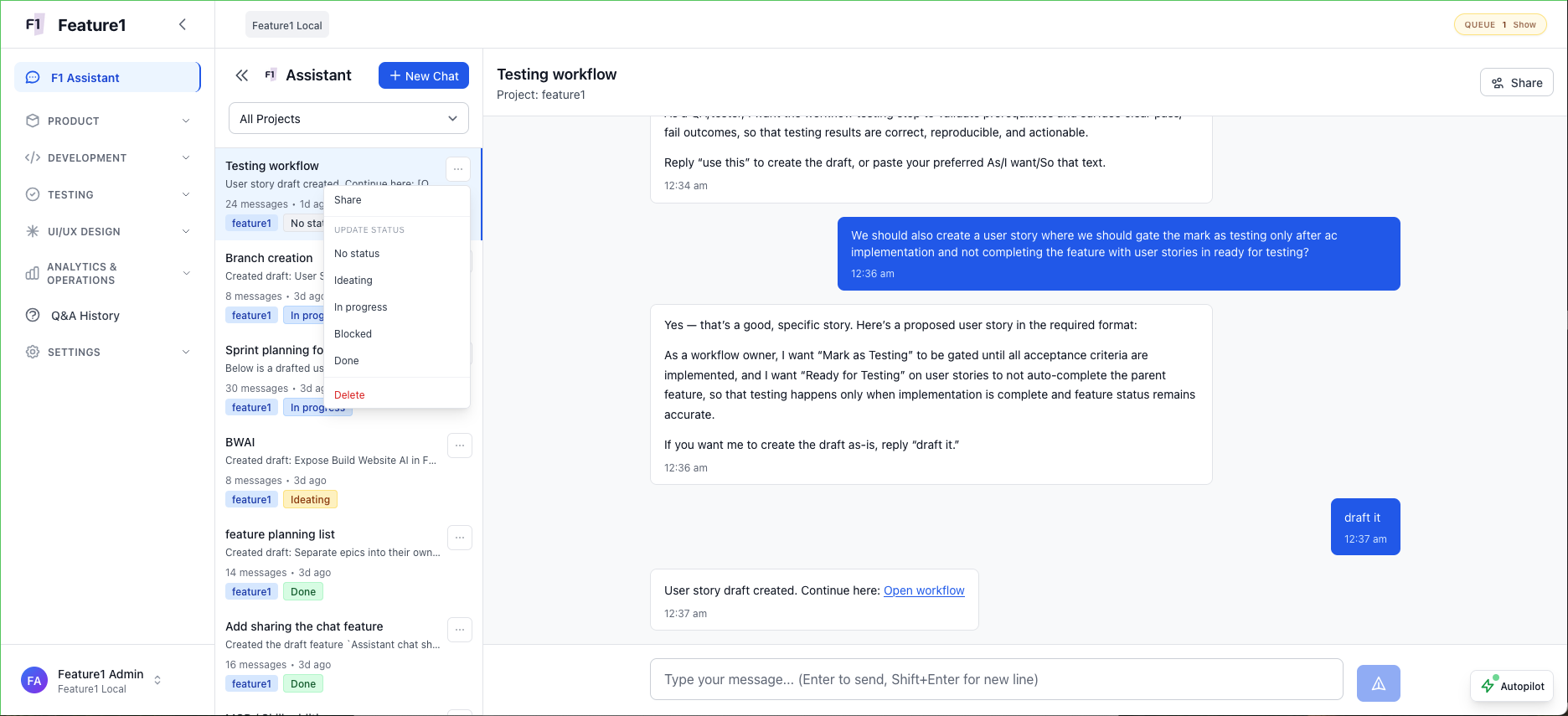
F1 Assistant: shared threads with status tracking (Ideating, In Progress, Done). Conversations turn into user story drafts with one message.
Problem 3: Plans That Can't Become Actions
ChatGPT gives you a plan. It cannot execute it. You still need to: manually write user stories in Jira or Linear, manually create acceptance criteria, manually assign to sprints, and manually track implementation. The plan and the execution are in completely different systems with no connection between them.
Feature1 turns plans into actions in the same platform. See the full plan-to-PR pipeline to understand how each step connects:
- Feature analysis generates structured user stories
- User stories generate testable acceptance criteria, using INVEST and CUTS/BATON principles
- Acceptance criteria are implemented by AI in Autopilot or Copilot mode
- Pull requests are created automatically
- The entire chain from idea to release-ready pull request is traceable
Problem 4: No Follow-Through
You planned the feature in ChatGPT three weeks ago. It has been implemented by your team. How do you verify the implementation matches the plan?
ChatGPT does not know what was built. It cannot compare the plan to the code. It has no visibility into what happened after the conversation ended.
Feature1 is different because your GitHub, GitLab, or Bitbucket repository is already connected. The AI agent runs directly in your codebase — every commit, every diff, every branch is visible to the platform. Feature1 doesn't just track which ACs are "done" — it knows the actual code changes that were made, which files were modified, and how the implementation maps to each acceptance criterion. The plan isn't a static document. It's a living workflow with full visibility into the codebase it changed.
When ChatGPT is Still Useful
To be fair: general-purpose AI chatbots are genuinely excellent for a real set of tasks. The point is not that they are bad — it is that feature planning for production codebases has specific requirements that they do not meet.
- Early-stage brainstorming before you have a codebase or established patterns to reason against
- Research and competitive analysis where codebase context is irrelevant
- Writing marketing copy or documentation where general language quality matters more than technical grounding
- Answering general technical questions that are not specific to your architecture or conventions
Use them for what they are built for. Use a purpose-built platform for the work that requires codebase knowledge, team coordination, and traceability from plan to merged PR.
Feature Planning That Actually Ships
Here is a direct comparison of what each approach gives you when you are trying to ship a real feature on a production codebase.
- Generic suggestions without codebase context
- Copy-paste workflow across multiple tools
- Plans disconnected from implementation
- No verification that code matches the plan
- Codebase-aware planning via Domain Spec
- Shared team threads with status tracking
- Plans → User Stories → ACs → Code → PRs in one platform
- Full visibility into code changes — repo is connected, every commit and diff is tracked
Explore the full platform feature set or see how it works to understand the complete workflow.