Most product teams still manage software as a sequence of features, tickets, releases, and roadmap items. That is understandable. Features are easy to name. Tickets are easy to assign. Releases are easy to announce. Roadmaps are easy to present.
Feature1 is built around this shift: helping teams understand what their product can do, how those capabilities are evolving, and what to improve next.
But customers do not experience your product as a set of tickets. They experience it as capabilities: the things your product enables them to do. A customer does not care whether onboarding required five stories, three services, two experiments, and a lifecycle email. They care whether the product helps a new user become successful.
This distinction matters. When teams plan only at the feature level, they can ship a lot of output without making the product meaningfully stronger. A feature can be technically complete and still fail to improve the larger capability it was meant to support.
Capability evolution is a more durable way to manage product development. It gives product and engineering teams a level of planning that sits between broad strategy and granular feature work. It helps leaders ask a better question: not just "what should we build next?" but "which product capability needs to mature next?"
The Problem with Feature-First Product Development
Feature-first planning breaks down because features are outputs. They describe what a team intends to ship, not necessarily what the product becomes better at doing.
A roadmap full of features can look healthy while the product experience remains fragmented. One team improves setup screens. Another adds notification settings. Another builds a reporting widget. Each feature may be useful in isolation, but if no one is managing the broader capability, the customer may still experience onboarding as confusing, analytics as shallow, or collaboration as inconsistent.
This is how roadmaps become lists of activity instead of instruments of product progress. Teams celebrate shipped work, but adoption is unclear. Launch communication is inconsistent. Technical health is treated as a separate concern. Competitive context is discussed during planning, then forgotten during delivery. Product and engineering decisions become fragmented because every ticket carries only a small slice of the larger intent.
The issue is not that features, tickets, and releases are wrong. Teams need them. The issue is that they are too granular to carry the full meaning of product development. They need to roll up into something more durable.
What Is a Product Capability?
A product capability is a durable product ability that creates customer or business value. It is something the product enables users, teams, or the business to do repeatedly over time.
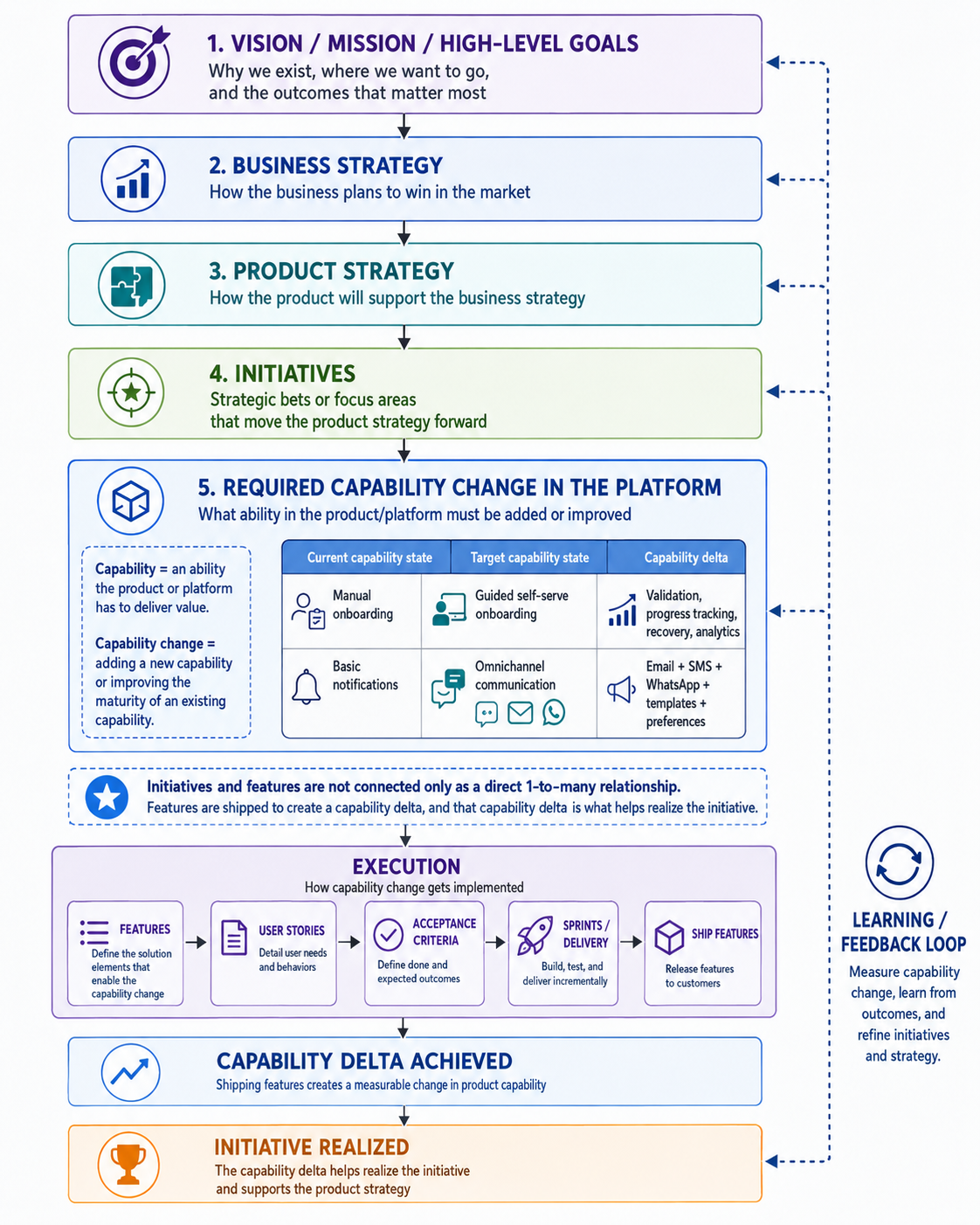
Capabilities sit between strategy and feature work. Strategy might say, "help teams ship higher-quality software faster." A capability might be "release communication" or "workflow automation." A feature might be "send a configurable launch email when a release goes live." The feature is a specific implementation. The capability is the product strength being developed.
Common capability categories include onboarding, sprint planning, release communication, analytics, workflow automation, collaboration, reporting, account management, governance, billing, and integrations. Each capability may be supported by multiple user flows, interface surfaces, technical systems, help content, lifecycle messages, and adoption signals.
That is why a capability is more useful than a feature as a management unit. It lets a product team consider the whole experience: what users can do, how easily they can do it, whether they know it exists, whether it works reliably, whether it is maintainable, and whether it is strong enough for the market the company wants to serve.
The Capability Evolution Framework
Capability evolution means managing the maturity of a product ability over time. It starts with understanding the current state of a capability, then deciding what should improve next.
A simple public-facing framework can help teams have a clearer conversation:
Strategy alignment
Why does this capability matter to the product strategy, customer segment, or business model?
Current implementation
What can users actually do today, and where does the experience begin and end?
Depth
How complete, useful, and coherent is the capability for the jobs users need to accomplish?
Adoption
Are users discovering and using it, and what demand signals suggest it matters?
Communication
Have users been made aware of the capability through launch notes, in-product surfaces, education, or customer-facing teams?
Health
Is the capability reliable, performant, and working well enough for the use cases it supports?
Maintainability
Can the team keep improving it without creating excessive complexity or slowing future development?
Market context
Is this capability table stakes, differentiating, or emerging in the category?
Next evolution
What should be improved, added, simplified, better communicated, or retired?
The value of the framework is not in creating a heavier planning ceremony. It is in forcing the right scope of thinking. A capability-level review connects product intent, customer behavior, engineering reality, and market expectations in one conversation.
It also helps teams avoid false confidence. A capability may look mature because several features have shipped, but adoption may be weak. Another capability may have strong demand but poor communication. Another may be strategically important but technically hard to maintain. Capability evolution makes those tradeoffs visible enough to manage.
Example: Evolving a Capability Over Time
Imagine a fictional SaaS product for operations teams. One of its important capabilities is release communication: helping teams tell customers and internal stakeholders what changed, why it matters, and what action they should take.
In the earliest version, release communication might be a simple changelog field attached to each release. That is a useful feature, but the capability is shallow. Users can write an update, but they may not know who should receive it, whether anyone read it, or how the message connects to customer segments.
The next evolution might add templates for different release types: bug fix, new feature, breaking change, beta announcement. That deepens the capability because teams can communicate more consistently. Later, the product might add audience targeting, approval workflows, or a way to connect release notes to adoption metrics. At some point, the team may discover that a complicated template system is rarely used and should be simplified.
Notice the operating model. The team is not just asking which release-note feature to build. It is asking how the release communication capability should mature. Does it need more depth? Better adoption? Clearer communication? Stronger health? Less complexity? A different answer leads to a different roadmap.
Why This Matters for PMs and Engineering Teams
For product managers, capability evolution creates a cleaner bridge between strategy and delivery. Strategy becomes easier to translate into roadmap decisions because every feature can be tied to the capability it strengthens. Planning becomes less reactive because teams can compare capability needs instead of debating isolated requests.
It also improves measurement. Instead of asking only whether a feature shipped, PMs can ask whether the capability became stronger. Did more users adopt it? Did support volume decline? Did the product communicate the change clearly? Did the experience become easier to use? Did the team reduce complexity while improving value?
For engineering leaders, capability evolution creates better context for technical decisions. Maintainability, reliability, and system quality are no longer detached from product planning. They become part of the capability discussion. If a strategically important capability is hard to maintain, that is not just an engineering concern. It is a product constraint.
This shared language reduces the common tension between product and engineering. Product can see why technical health affects the future of a capability. Engineering can see why certain investments matter to customers and the market. The conversation shifts from "why are we doing this ticket?" to "what does this capability need in order to mature?"
How Feature1 Thinks About This
Feature1 helps teams organize product development around evolving capabilities. It brings product, engineering, customer, and market signals into one capability-level view so teams can reason about what the product can do today and what should improve next.
That matters because modern product development is no longer a straight line from idea to ticket to release. Product teams need to connect strategy, planning, execution, communication, and learning into one operating model. They need to understand what is already shipped, what is in progress, what customers are asking for, how a capability is being adopted, and whether the product is getting stronger over time.
Feature1 is designed for product builders who want that operating model. It helps teams decide what capability to deepen, what feature to plan next, and how to measure whether the product is becoming more valuable, usable, and resilient.
The point is not to replace features, roadmaps, or delivery workflows. The point is to give them a better organizing layer. Features still ship. Tickets still get assigned. Releases still go out. But the work is connected to a clearer question: which product capability are we evolving, and why now?
Closing Takeaway
Product teams do not win by shipping disconnected features faster. They win by steadily improving the capabilities that make their product more useful, differentiated, reliable, and adopted.
Capability evolution gives teams a practical way to manage that improvement. It turns product development from a list of outputs into a system for building stronger products over time.