





Spec with context, not without it
Specs start from your strategy, what the product does today and what customers are saying. Nobody rebuilds that context by hand for every feature.
Feature1 is the operating system for your product org. Your PMs spec with the full context of your strategy, code, usage and customers. Engineering gets handoffs with the risks already found. Less rework, faster decisions, and one PM doing the work of three.
No PM yet? Get an experienced PM from our pool, working in Feature1 →
Works with GitHub, GitLab, Bitbucket and your existing workflow.
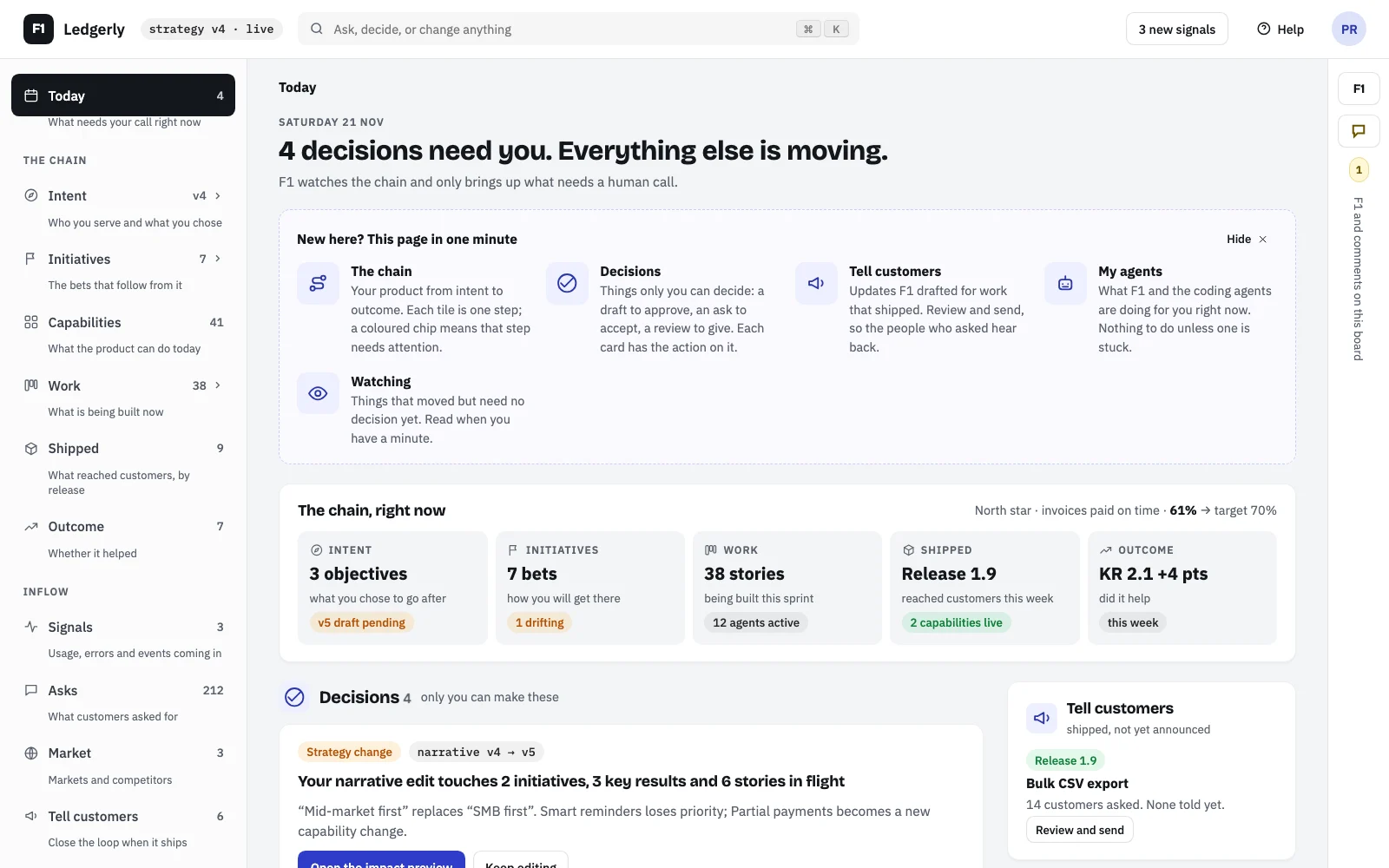
From a goal, to the roadmap, to the specs, to a coding agent building it.
Most of a product team’s time goes into gathering context, chasing alignment and fixing what was built on the wrong assumption. Feature1 removes that work, so the same team ships three times the product.
Specs start from your strategy, what the product does today and what customers are saying. Nobody rebuilds that context by hand for every feature.
Open questions, contradictions with existing behaviour and risks are found before engineering starts. Complete alignment, full focus, no waste.
Ideas move from goal to prioritised, dev-ready specs in days. Engineering handoff is clear because the risks are already on the table.
Founder-led teams without a product manager, or still hiring one, get an experienced PM from our consultant pool, working in Feature1. Every spec, decision and metric lives in Feature1, so you see all the work and it stays with you when your own PM joins.
A PM from our consultant pool, from a few hours a month, with one primary PM for continuity.
Priorities, specs, reviews and metrics are all in Feature1, linked from goal to release. Nothing is hidden in someone else’s documents.
When you hire your own PM, they inherit an organised backlog, the decisions behind it and the metrics set-up, and keep working in Feature1.
Once developers work with coding agents, code is no longer the slow part. Working out what to build, and writing it down clearly enough for an agent to build it, is. We saw the same thing at each of our customers.
A strategy doc tells you where you want to go. Product signals tell you where you are. Feature1 puts them side by side, so a roadmap item comes with the evidence for it, and after release you can see whether it worked.
Which parts of the product people use, and which they stop using.
Amplitude, Mixpanel, PostHog, Heap
Error rates, slow pages, open alerts, and Apdex where your tool reports it.
Sentry, Datadog, New Relic, Rollbar
Support tickets, calls, surveys and bug reports, linked to the part of the product they are about.
Intercom, Zendesk, Freshdesk, Gong, Delighted, Typeform
From the first signal to the result after release. Each step stays linked to the one before it, so anyone can see why a change was made.
Open any shipped change and you can see the signal, the goal, the spec and the acceptance criteria behind it. Nobody re-types anything.
Strategy to roadmap to a Claude Code handoff, in two minutes.
Feature1 keeps the answers in one place, for your team, for your coding agents, and for whoever asks six months from now why something exists.
Writing a spec is the easy part. Feature1 keeps the decision, and the evidence for it, attached from the first signal to the merged code.
Feature1 asks the product, technical and strategy questions a good PM would, checks the request against what the product already does, and lists the assumptions before a PRD is approved.
Open questions come up before the build, not during it.
Developers and their coding agents get the objective, the intent of the feature, the acceptance criteria and the constraints. Not a one-line ticket.
The agent builds what was agreed.
Each team and each coding agent reads the same record of what the product does, why the last change was made, and what customers said about it.
Nobody rebuilds the context every sprint.
Start with what the product can already do, say what you want to change, and plan only the work needed to get there.
When a change is merged, Feature1 can rescan the repository and update what it knows the product can do. The strategy stays tied to the software as it is now.
Feature1 connects to your code on GitHub, GitLab or Bitbucket, to your analytics, monitoring and support tools, and to the coding agents your developers already use (Claude Code, Codex, Cursor) over MCP.
An upcoming text-to-speech app for your own books and articles. Upload a PDF, EPUB, Word, HTML or text file and listen while you work, walk or get on with your day.
Feature1 manages the product. mvpfy builds it. BeyondWebsite takes it to market. All three work from the same understanding of your product, and our open-source tools extend them.
Take what you have built to market and keep it current.
Help PMs and founders safely work against real codebases.
Turn software APIs into conversational agents.
Turn organizational knowledge into conversational interfaces.
Feature1 has been in production use since 28 December 2025. Every figure below is counted from the production database, not estimated. No customer is named and no number is broken down far enough to identify one.
Recorded 9 October 2026 · 285 days of production use
Manage durable capabilities instead of disconnected feature output.
FEATURE PLANNINGFeature planning needs context, collaboration and executable output.
ENGINEERINGKeep AI-generated code aligned with intent and review quality.
Feature1 is product management software for teams whose developers build with AI coding agents. It puts your product strategy next to real product signals, helps your team decide what to build, turns that into specs with acceptance criteria, and lets coding agents such as Claude Code, Codex and Cursor build from those specs over MCP. After release, the same signals show whether the change worked.
Coding agents made building fast. Deciding what to build, and writing it down clearly enough for an agent to build it, did not get faster, so it is now the bottleneck. Feature1 helps product managers and founders make that decision from evidence and hand it to developers and their agents in a form they can build from.
Adoption from Amplitude, Mixpanel, PostHog or Heap. Product health from Sentry, Datadog, New Relic or Rollbar, including error rates, latency, open alerts and Apdex where the tool reports it. What customers say in Intercom, Zendesk, Freshdesk, Gong, Delighted or Typeform. Deals and accounts from HubSpot, Salesforce, Pipedrive or Zoho.
Any coding agent that supports MCP, including Claude Code, Codex and Cursor. The Feature1 MCP server exposes 114 tools for strategy, planning, stories, acceptance criteria, sprints and repository context. Feature1 reads code from GitHub, GitLab and Bitbucket, and is listed on GitHub Marketplace.
ChatPRD and GitHub spec-kit write a spec document. Jira, Linear and Productboard track work after it is decided. Feature1 holds the decision itself: it checks a request against what the code already does and against product signals, keeps the strategy, roadmap, specs and acceptance criteria connected, and lets the coding agent read them directly.
Software companies, usually 11 to 200 people, where developers already use AI coding agents and the product managers or the founder have become the bottleneck. It is built for the product manager, the head of product or CPO, and the founder who decides what gets built.
Professional is $199 per product manager per month, or ₹14,999 per product manager per month plus 18% GST in India. Each product manager seat includes four collaborator seats for engineers, QA and leadership. Enterprise adds on-prem and private deployment and is priced per deployment. There is a 7-day free trial with no credit card.
On a call we take one real goal of yours, look at your code and your product signals, and plan the first feature with you.